Info
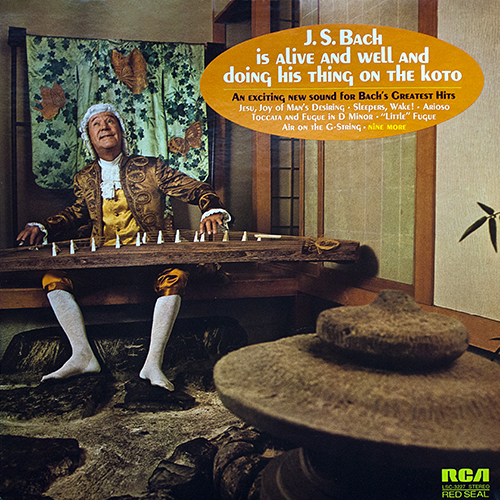
- Artist:: 沢井忠夫
- Album:: J.S. Bach Is Alive And Well And Doing His Thing On The Koto
- Year:: 1970
- Label:: RCA Red Seal
- Catalog:: LSC-3227
Track Ratings
| # | Title | Rating |
|---|---|---|
| A1 | Toccata And Fugue In D Minor | |
| A2 | Jesu, Joy Of Man’s Desiring | ★ |
| A3 | Prelude No. 1 | ★ |
| A4 | Fugue No. 1 (From The Well-Tempered Clavier, Book I) | |
| A5 | Sleepers, Wake! | ★ |
| A6 | Polonaise (From Orchestral Suite No. 2) | ★ |
| A7 | Bourrée I (From English Suite No. 2) | |
| A8 | Two-Part Invention No. 1 | ★ |
| B1 | Air On The G-String (From Orchestral Suite No. 3) | |
| B2 | Minuet In G (From The Notebook For Anna Magdalena) | ★★ |
| B3 | Arioso (Sinfonia From Cantata No. 156) | ★ |
| B4 | Gavotte I (From English Suite No. 3) | |
| B5 | Bourrée (From Partita No. 1 For Solo Violin) | ★ |
| B6 | Minuet In G Minor (From The Notebook For Anna Magdalena) | ★ |
| B7 | ”Little” Fugue In G Minor | ★ |
Log
2024-07-26
i really wonder what bach’s influence upon japanese composers was, since i tend to hear bach’s shadow in their music.
maybe there’s a difference in how the classical canon is both composed and weighted there? because here the big three are bach, mozart, and beethoven; yet it feels like they’re taught as if their relative importance increases chronologically.1 and in hindsight, i’m not sure how true that judgment really is – if anything, it just reflects a shift in priorities as to what we want out of music, collectively.2 but maybe over there it’s different?3
★ jesu, because always jesu. does it being jazzy add to it? detract from it? i dunno, but it distracts me from where i want to be.
★ prelude no. 1
★ sleepers, wake! i’m not sure if i’ve heard this one before!
★ polonaise
★ two part invention no. 1
i always forget that bach composed air. and, while i dislike when other artists stuff air into their albums, here it makes sense. so here and only here it gets a pass.
★★ minuet in g. formative attachments never die.
★ arioso
★ bourree
★ i’m not sure if i ever heard the minuet in g minor either
★ little fugue in g minor
Footnotes
-
or it just reflects piano teachers’ own priorities, since beethoven heavily used both the forte and the piano out of his fortepiano, and bach didn’t really compose for the instrument at all1 ↩
-
i kinda wonder how i would’ve developed, were i taught by someone else and put through like the suzuki method. i probably would have greater hand-independence, since it’s easy to automate the left hand with romantic-era works and, whenever i was handed a fugue, it would absolutely filter me. but i also could see myself hating it all the while and giving up on music entirely, since the rigidity and precision it demands appeals to me very little, and i like being both forte and piano! it’s what i want out of music2 ↩ ↩2